
Working together beyond a conversation
A shared space can make an idea tangible. People can examine a design, try a different arrangement and see how their contributions relate to one another.
The research question is what changes when AI can participate in that space. A useful environment needs to distinguish a suggestion from an accepted action and preserve a clear account of what changed.
The foundations under development
The implementation combines a browser-based 3D interface, shared scene state and a physics engine. Signed operations and a policy gate provide a way to check proposed changes before accepting them.
These mechanisms address parts of the collaboration problem: keeping contributions attributable, coordinating updates and examining whether a change fits the applicable rules. The overall project remains in progress.
A shared scene, with wider connections
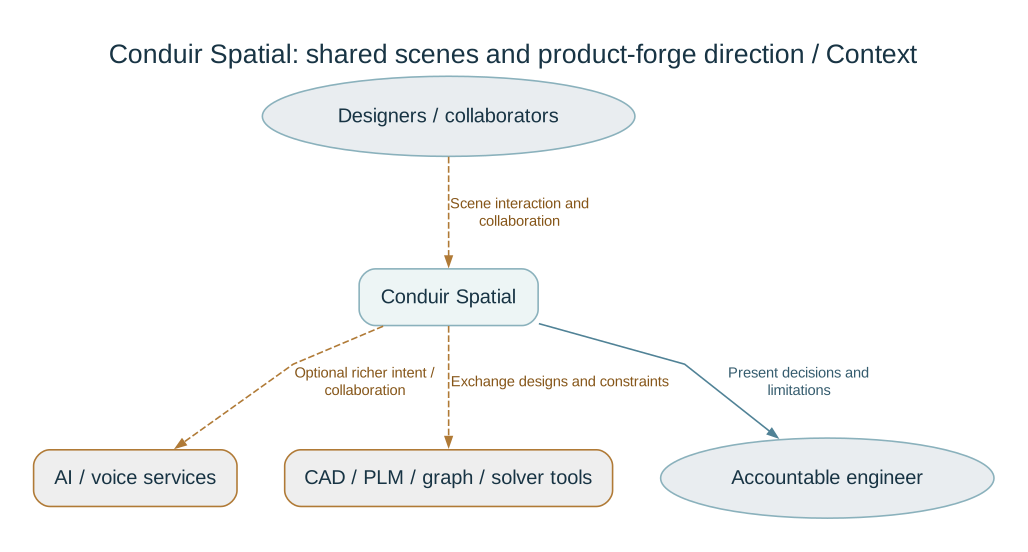
What has been tested
A red-team harness exercised a bounded set of attempts to bypass the action rules. A separate physics check examined whether separate engine instances reproduced the same state over a fixed simulation run.
The two results answer different questions. One examines specific attempts to bypass the intended action rules; the other examines repeatability in a bounded simulation. Neither is a general claim about every browser, device or possible interaction.
Towards shared realities
Spatial is work architected at Fifth9 and contributes to the shared-worlds horizon. A room that people and agents can change together is one possible setting for design, practice and exploration.
The next direction is a meaningful co-creation activity in which the value of that shared setting can be assessed. The focus is what people can understand and accomplish together, supported by clear control over the changes made around them.