Review subject
Define exactly what the panel is examining.
- Receives
- A work product, its context and review questions.
- Produces
- A shared review brief.
 AI Initiative
Work architected at Fifth9
The panel separates review from adjudication. Different models examine the same subject; their findings are then challenged, consolidated and checked against that subject. The useful output is a traceable set of dispositions, not a vote that declares the work correct.
Review mechanism The public panel description covers review. Broader mutation and evolution experiments are separate from this capability.
The design question
Turn proposed concerns from different reviewers into findings that a person can assess and act on.
Different models can offer different perspectives, but repeated model instances are not automatically independent reviewers. The composition of the panel and any missing participation matter when interpreting the breadth of the review.
The work and its evidence anchor the review. Model perspectives contribute concerns; verification and recorded uncertainty inform the person responsible for the decision.
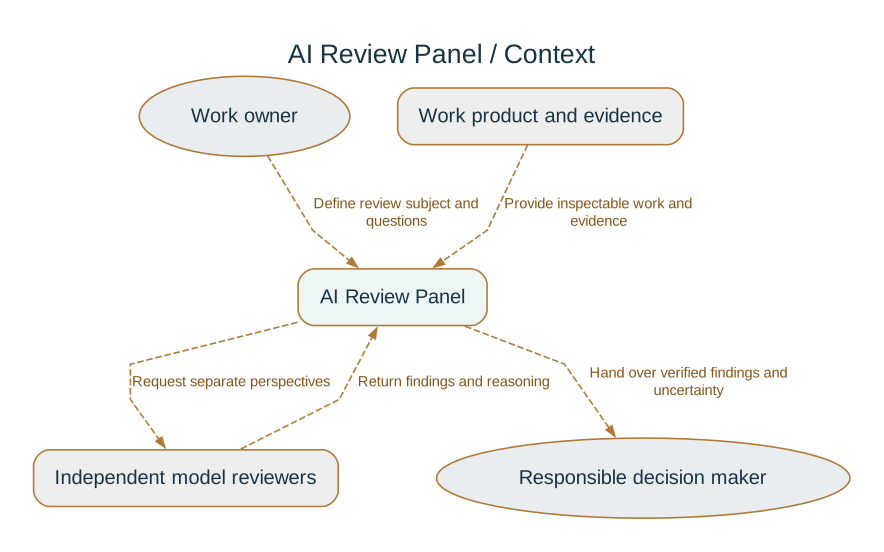
Follow one review subject through participating model perspectives, verification of concerns and recorded dispositions to the responsible decision-maker.
What each part is responsible for
Define exactly what the panel is examining.
Bring different model perspectives to the same subject.
Examine whether each concern is supported.
Consolidate repeated concerns and preserve their treatment.
Give the responsible person useful input for the next action.
Following one piece of work
Give reviewers the same bounded piece of actual work and the question they are meant to examine. An ambiguous review scope can produce impressive-sounding concerns that are irrelevant to the decision.
Obtain findings from the available model panel. Record the perspectives that actually participate. Availability and model-family diversity affect how the review should be interpreted, so a narrower panel should remain visible as such.
Investigate the proposed findings against the artifact and supporting evidence. A concern may be supported, disproved or still uncertain; persuasive wording and repeated agreement do not decide that disposition.
Combine duplicates, prioritise the concerns that remain useful and record each disposition. Preserve enough reasoning to explain why an item was accepted, revised, deferred or rejected.
Give the person or workflow responsible for the next action the findings and their dispositions. The panel helps determine what deserves attention; accepting a finding and authorising a release remain separate decisions.
Illustrative example · not a benchmark result
A team wants to review an architectural change.
The useful result: A smaller, clearer set of findings with reasons for their disposition.
A generic review pattern, not a claim that model agreement eliminates defects.
Findings become useful through examination. A concern needs enough connection to the work to be investigated, duplicates need to be combined, and dispositions need reasons. Agreement can guide attention; it does not replace verification or transfer release authority to the panel.
Reading the architecture accurately
Where the design must hold up
| Boundary | Why it matters | How to examine it |
|---|---|---|
| Perspective diversity | Several agents are not necessarily several independent perspectives. | Record which perspectives actually participated, including missing or unavailable reviewers. |
| Supported findings | Model agreement does not establish correctness. | Trace each retained finding to the work that supports it and record unsupported or duplicate concerns. |
| Release authority | A review result does not itself grant release authority. | Keep the final decision with the responsible process and examine whether accepted findings improved the work. |