
A place to ask measurable questions
Poker combines incomplete information, changing circumstances and consequences that can be recorded. It provides a practical starting point for research into learning and adaptation, without defining the full range of challenges the programme may explore.
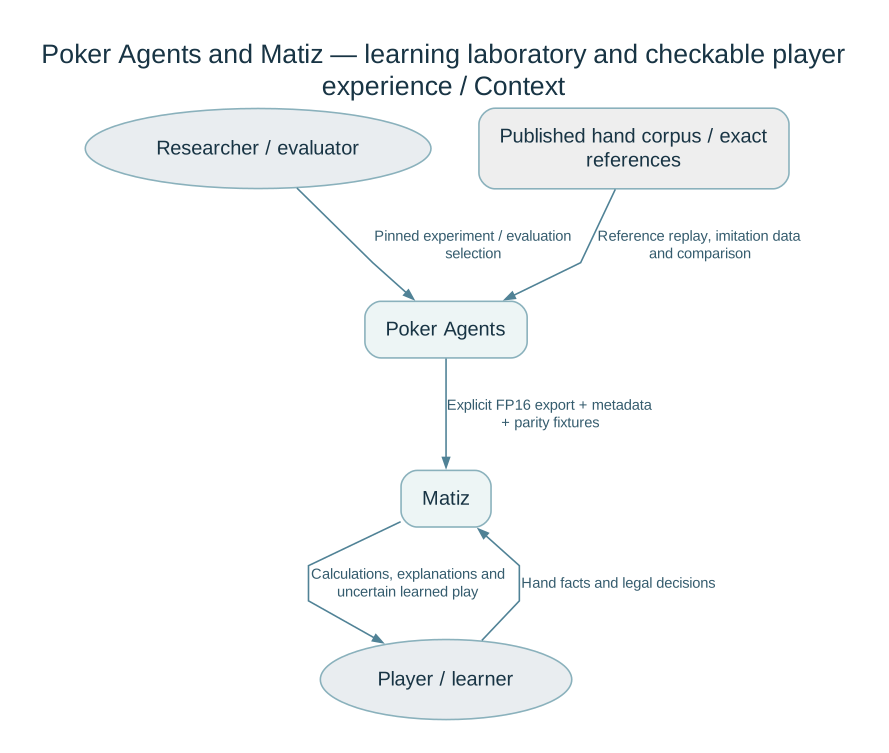
The work separates several questions: whether the game engine is correct, how an agent performs, what a model learns and how the experience can be presented to a player.
From rules to agent behaviour
The hold’em engine reproduced the finishing stacks of 10,000 public Pluribus-versus-professional hands to the chip. This validates payout replay. Agent behaviour is examined separately, including imitation of professional actions and a local benchmark comparing 20 versions against eight opponent families on paired deals.
Separate, pre-registered heads-up evaluations against Slumbot and GTO Wizard AI were losses. Those matches are retained in the account of the work alongside the local results, rather than treating performance in one setting as a universal ranking.
From research to player experience
Learning that carries forward
In a separate modular-network experiment, a frozen concept trunk reached the river-task target in a mean of 942 training steps, compared with 1,801 from scratch, across five paired seeds. The original task remained intact in that experiment.
The comparison excludes donor pretraining. It is evidence about target-task learning in that setup, and motivates further tests of what transfers when the task or representation changes. It does not establish a general halving of training cost.
From the experiment to an experience
The Matiz application brings poker play, odds and outs into a usable surface, with exact calculations where they can be enumerated and simulation estimates elsewhere. Its application experience and the research evaluations have distinct purposes.
The longer direction is towards extensible environments: new tasks, different conditions and more demanding tests of transfer. Poker is one early step towards investigating how learning can become useful beyond the setting in which it began.