Task brief
Describe the work and its intended result.
- Receives
- Requirements and constraints.
- Produces
- A shared starting point for the workflow.
 AI Initiative
Work architected at Fifth9
Maestro approached coordination through specialist roles, workflow structure and continuing session context. The later Maestro Platform broadened the engineering foundation; Conduir carried forward implementation and architectural work from that history.
Earlier platform work This explains an earlier coordination architecture and its lineage. It does not identify Maestro, Conduir and AI Engineering Workforce as interchangeable products.
The design question
Organise the different kinds of work needed to turn an idea into a reviewed result.
Specialisation helps organise a task, but each role still needs a clear responsibility and usable context. A handover should carry the decision, its reason and the next question; passing only the latest output can leave the next contributor to recreate the intent.
A work brief reaches specialist roles through coordination. Their contributions return with handover context, and a reviewer relates the combined result to the original request.
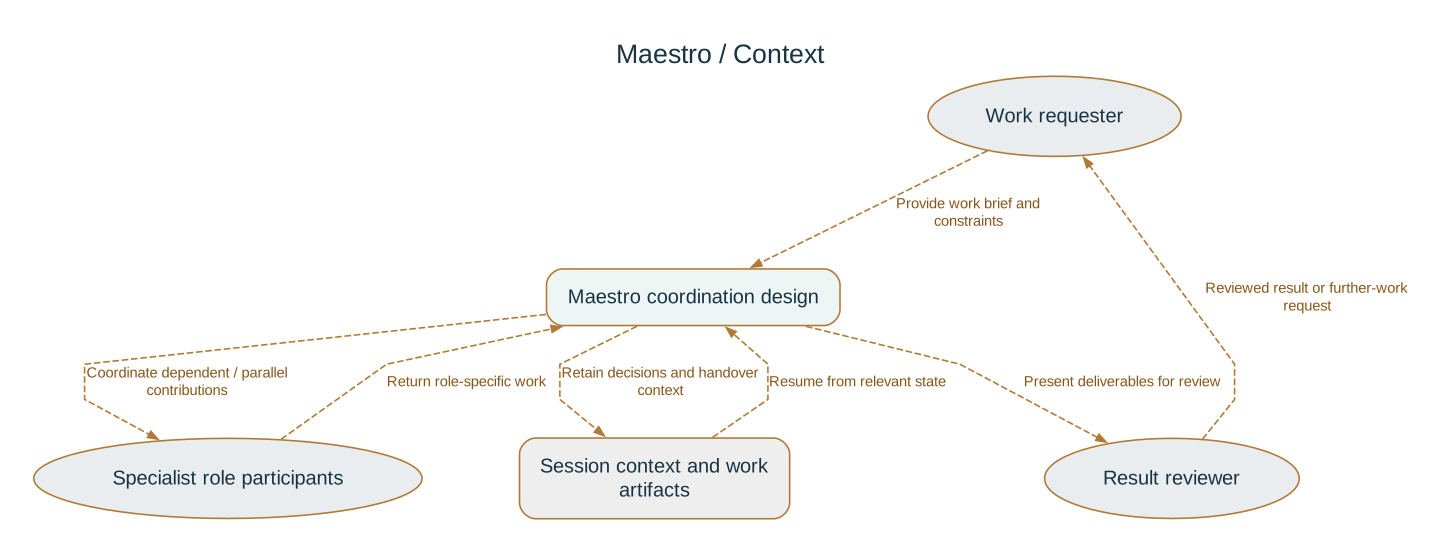
Keep context, responsibility and the boundary between a proposal and an accepted result visible.
What each part is responsible for
Describe the work and its intended result.
Give different activities distinct responsibilities.
Organise dependencies and parallel contributions.
Keep useful task state available when work continues.
Bring outputs back to the question the work was meant to answer.
Following one piece of work
Make the request understandable as work with an intended outcome. Requirements that remain uncertain should be carried explicitly into later stages rather than silently replaced by an assistant’s assumptions.
Select specialist responsibilities appropriate to the task. Role names organise contributions, but the resulting work still needs to be assessed for the specific question it is answering.
Arrange compatible contributions in the needed sequence or parallel structure. Dependencies matter: a later stage must be able to recognise when required context or decisions are still missing.
Preserve decisions, unresolved questions and the latest work for handovers or resumption. Resuming a session should restore the meaning of the activity, not merely a list of files or earlier messages.
Bring testing and review of the combined output back to the original request. The output may need revision, further information or a narrower claim; a chain of completed role steps does not itself establish a useful result.
Illustrative example · not a benchmark result
A person wants a first version of a small application.
The useful result: A contribution that can be reviewed and resumed with its purpose still intact.
A generic explanation of the workflow architecture, not a promise of unattended application delivery.
Resumable work also needs to distinguish a previous plan from completed action. The earlier engine and broader platform contributed foundations to later work; their history does not make every modern Conduir capability part of one unchanged product.
Reading the architecture accurately
Where the design must hold up
| Boundary | Why it matters | How to examine it |
|---|---|---|
| Role competence | A persona name does not establish expertise on a task. | Give a role a bounded task and examine the usefulness of its contribution. |
| Usable handovers | A successful handover requires usable context, not just a completion message. | Resume an interrupted workflow and check whether its decisions and unresolved questions survive. |
| Historical scope | Earlier platform work and present integration state are different claims. | Identify which capability belongs to the earlier engine, wider platform or subsequent work before making a combined claim. |