The reusable toolkit supports making and checking experiences. Its role is to give an idea a dependable starting point and an understandable route through review, while preserving the creative work and attribution of the people contributing it.
Creation, review and release have different roles
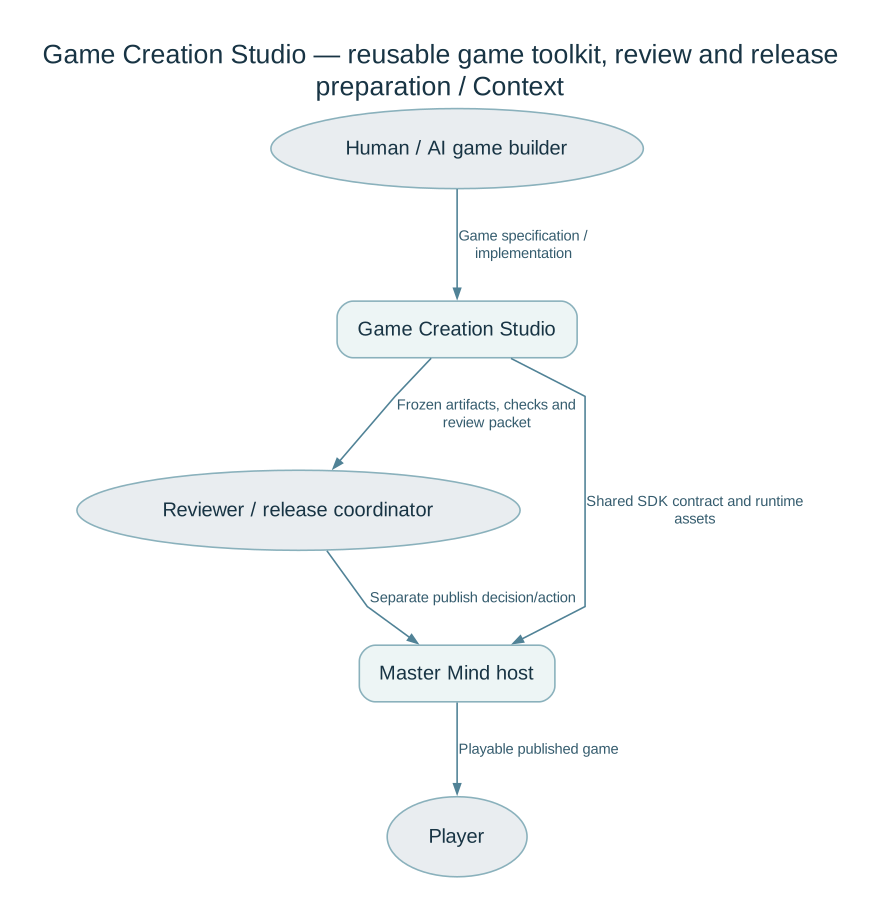
A builder develops the game through reusable foundations. Review examines the version and its checks; a separate publication action connects an accepted version to the host and player.
Retained context diagram for Game Creation Studio. It separates the toolkit, reviewer, host and player experience; a published-game node is a destination in the workflow, not a release announcement. Open the full-size diagram ↗
Follow an idea through shared game foundations, difficult-path checks and preparation of a reviewable version. Publication remains a separate decision.
A responsibility-level flow through the work. It does not imply that separate experiments or applications are one deployed service. Select a step to read its walkthrough.
What each part is responsible for
The building blocks
Starting templates
Provide a small working structure for different game types so a creator can concentrate on the game-specific rules and presentation.
Receives
A game idea, intended audience and interaction type
Produces
A small working starting structure
Round lifecycle
Coordinates starting, playing, pausing, resuming and ending a round, including ownership of resources created during play.
Receives
Player input and the current round phase
Produces
A controlled transition between play states
Input and layout
Adapts supported controls and the play surface to the device while preserving a usable route through menus and gameplay.
Receives
Device capabilities and intended interactions
Produces
A usable control and presentation path
State and saves
Keeps game progress separate from temporary round state, handles versioned saves and makes failed storage visible.
Receives
Progress, saved versions and storage outcomes
Produces
Restored progress or a visible failure
Display handling
Applies the configured text-handling policy at the point where dynamic content enters and is displayed. Unavailable checks should not silently become permission to display everything.
Receives
Dynamic material and configured display requirements
Produces
Material accepted for display or withheld
Game-specific logic
Contains the actual rules, challenge and creative decisions. Reusable foundations do not replace the author’s contribution.
Receives
Player input and the current game state
Produces
The next state, challenge response or result
Checks and release preparation
Examines source and runtime behaviour, packages a defined version and leaves publication as a separate decision.
Receives
A defined candidate and checks appropriate to it
Produces
Review findings and a prepared version
Following one piece of work
How the flow fits together
01Begin with an experience
Specify the idea and intended audience before choosing a template. The reusable layer provides working foundations; the challenge, creative direction and the experience worth returning to still need to be designed.
02Connect the foundations
Start from the appropriate structure and connect game-specific rules to input, layout, round state and saves. Shared behaviour should reduce repeated engineering while making it clear which state belongs to a round, a player or a saved version.
03Build and review
AI-assisted authoring can produce and revise implementation, while separate review examines the changes. Dynamic material passes through the configured display handling. Neither assistance during creation nor an ordinary saved state means the game itself learns through a neural model.
04Exercise the difficult paths
Check more than the happy path: pause and resume, navigation, small screens, storage failures and incompatible saved versions. Deliberately introduced faults can help establish whether checks detect the failure they are meant to detect.
05Prepare a version
Collect a defined candidate and its relevant checks for review. A quick initial pass, full release preparation and actual publication are separate milestones. Player feedback and creative judgement remain necessary even when the technical checks pass.
Illustrative example · not a benchmark result
Illustrative creation flow
A creator wants a small word puzzle.
Start from a matching template, add the challenge and answer rules, reuse input and save behaviour, then test play, pause, small screens and storage failures.
The useful result: A reviewable playable candidate with its shared foundations already connected.
Passing technical checks does not establish that the puzzle is enjoyable, educationally effective or suitable for every audience.
What is learned, remembered or calculated?
Learning: AI can assist authoring and review. That does not mean the resulting game trains a neural model or adapts through machine learning.
Memory: Saved progress and preferences support continuity for the player; they are ordinary application state.
Exact computation: Game rules and selected mathematical exercises can use deterministic calculation. Correctness depends on the rule and the implementation, not on a model’s confidence.
Authorship: The toolkit supplies reusable engineering. Game ideas and creative contributions keep their own attribution.
Reading the architecture accurately
Scope and status
What the work covers
A creation toolkit and engineering workflow. It is separate from any AI trained inside a game and from a player-facing AI feature.
AI can assist authoring and review. That does not mean the resulting game trains a neural model or adapts through machine learning.
Saved progress and preferences support continuity for the player; they are ordinary application state.
Game rules and selected mathematical exercises can use deterministic calculation. Correctness depends on the rule and the implementation, not on a model’s confidence.
What this work does not establish
Automatic publication.
AI-powered gameplay in every game made with the toolkit.
Guaranteed enjoyment or educational effectiveness.
Universal child-safety certification.
Where the design must hold up
Boundaries and evaluation
Boundary
Why it matters
How to examine it
Saved-version compatibility
A saved file from a newer game version must not be silently overwritten by an older implementation.
Try the older implementation with a newer saved version and check that it preserves the data or refuses the unsupported version explicitly.
Storage failure
A failed write must not be presented as successfully saved progress.
Exercise unavailable or failing storage and inspect both the actual saved state and the message shown to the player.
Round and player ownership
Pause, navigation and player changes can expose resource or ownership mistakes.
Exercise repeated pause/resume, navigation and player changes; check that old round activity does not alter the wrong state.
Content handling
Text filtering and content review have limits; no blanket guarantee of child safety is implied.
Exercise unavailable checks and relevant content edge cases, inspect what reaches display and retain appropriate human content review.
Release milestones
A fast initial test pass is not equivalent to complete release preparation or publication.
Identify which checks ran against which candidate, which release conditions remain and whether publication actually occurred.
Continue the thread
Where this connects
Games are the current route to bringing the wider vision into people’s lives. Creation tooling helps make an experience possible; what people enjoy, learn and choose to return to remains the practical test.