Capture and scope
Record relevant information with its intended scope.
- Receives
- Conversation, work events and operator contributions.
- Produces
- Scoped records with their origin and purpose.
 AI Initiative
Work architected at Fifth9
Cortex separates capturing information, preserving its context, retrieving relevant records and caring for the resulting memory. Memory retrieval provides evidence to a task; it is a different mechanism from changing the parameters of a neural model.
Memory architecture and implementation work The explanatory layers group responsibilities. They do not claim that every proposed memory tier or learning loop is operational.
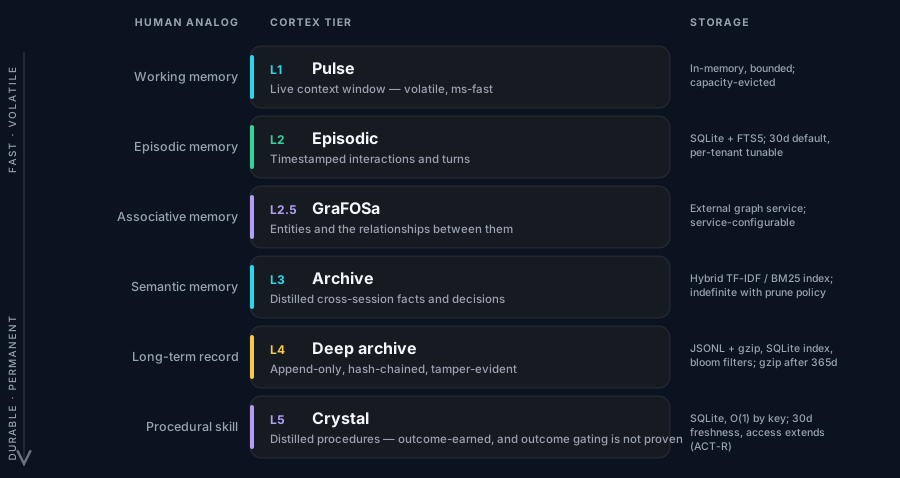
Cortex layers, recall and learning boundaries ↗ · Original six-tier memory diagram ↗
The detailed view includes additional layers and ownership boundaries; the original six-tier graphic retains its historical scope.
The design question
Help a continuing collaboration recover what matters, where it came from and why it was retained.
Useful memory is more than storage. A retained statement needs enough context to answer who it concerns, where it came from and whether it still applies. Retrieval should help a collaborator inspect relevant evidence, not promote any remembered sentence into unquestionable fact.
Read down from working context to episodes, associations, semantic knowledge, longer-term records and reusable procedures. Each layer has a different purpose and lifetime.
Keep context, responsibility and the boundary between a proposal and an accepted result visible.
What each part is responsible for
Record relevant information with its intended scope.
Support immediate context and records that outlast a session.
Keep the origin and development of information inspectable.
Find material relevant to the current question.
Manage correction, retention and removal over time.
Following one piece of work
Retain a contribution with its purpose, origin and enough context to understand what it refers to. A useful memory should remain distinguishable from a model-generated guess or an observation about a different situation.
Distinguish the context needed for an immediate task from records intended to remain useful later. The explanatory layers describe different lifetimes and responsibilities, not a promise that every proposed memory tier is operational.
Ask what information this task needs and retrieve within the relevant scope. A semantically similar record can still be outdated, incomplete or inappropriate for the current question.
Interpret the evidence and check whether it actually helps answer the question. The person or reviewing process still needs to judge whether the context supports the recommendation; retrieval quality and answer quality are separate questions.
Reconsider mistaken or obsolete context and decide what should remain available. Retention, correction and forgetting need an account of derived records as well as original material, and their effects should be examined explicitly.
Illustrative example · not a benchmark result
A team returns to a design decision after several weeks.
The useful result: Relevant earlier context that the person can inspect and correct.
Illustrates useful continuity, not a guarantee of recall accuracy or an already-proven outcome-learning loop.
Memory care and learning have different jobs. Correcting a record, changing retention or improving retrieval does not necessarily change a model’s learned capabilities. The architecture makes room for those processes while leaving each improvement claim to an appropriate evaluation.
Reading the architecture accurately
Where the design must hold up
| Boundary | Why it matters | How to examine it |
|---|---|---|
| Retrieval versus answers | Retrieving relevant evidence does not guarantee a correct final answer. | Assess retrieval separately from the final answer and inspect the supporting records. |
| Scope and retention | Retention must preserve scope and permit correction or forgetting. | Test relevant scope boundaries, corrections and the effects of retention choices. |
| Measured improvement | Recorded outcomes do not prove that memory quality improves because of them. | Compare an explicit memory change against an appropriate baseline instead of inferring improvement from new records. |