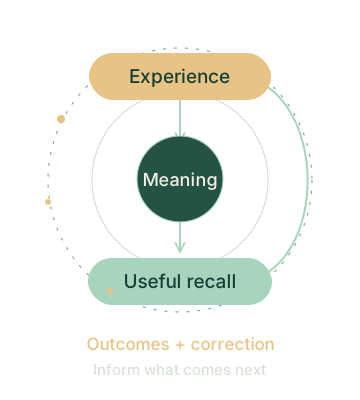
The next conversation should build on the last. Useful memory carries forward the purpose behind a decision, the experience that shaped it, and the questions still open.
Cortex brings together work on persistent memory, relevant recall and learning from outcomes. The ambition is continuity that can survive a new session, a different model or a changing team—with room to question and correct what was learned.
Keep the experience. Carry forward the understanding.
Architecture + implementation + research
Work architected at Fifth9. The map brings together implemented mechanisms and continuing research; it does not represent one fully proven, integrated system.
Explore the architecture
Experience becomes useful when its meaning travels.
Memory is a connected set of responsibilities: capture what matters, organise it, bring it back into the right situation, and revise it when the evidence changes. Open a stage to see the mechanism and its trade-off.
Purpose, origins and sharing boundaries travel with the information—not just the words.
Across model changes ↓Explore how useful understanding could outlast an individual model.
01Capture with purposePreserve the reasons, not only the answer.
A decision means little without its constraints. Capture brings together the contribution, its source, the task it belongs to and the reason it was useful. An observation, a person’s preference and a model’s suggestion need different treatment.
Comes in
A conversation, work event or reviewed contribution.
Stays with it
Who or what it concerns, where it came from, when it applied and who may use it.
Design choice
Retaining everything creates noise and unnecessary exposure. Capture should be selective, with explicit retention and correction choices.
In the team example: preserve “we chose batch processing because a daily update was enough,” alongside the choice itself.
02Give memory different jobsContext, experience, knowledge and procedures.
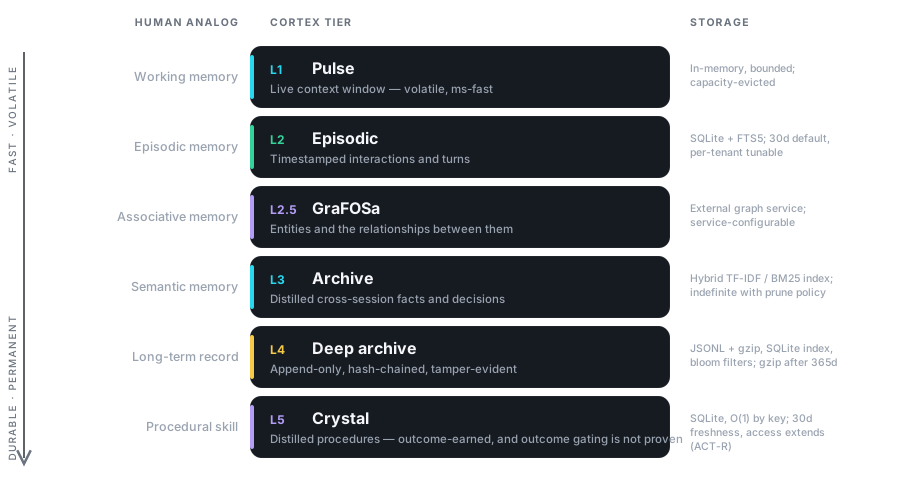
Different forms of memory serve different timescales. These are explanatory groups of responsibilities; they are not a ladder that automatically promotes every saved conversation.
Working context
The current question, active constraints and selected evidence. Keep it small enough to remain useful.
Experience and archive
Earlier conversations, decisions and outcomes, retained with their history. An archive preserves a record; it does not make every record relevant.
Connected knowledge
Facts, entities and relationships extracted or linked across experiences. Keep the route back to their sources so a summary can be challenged.
Reusable procedures
Candidate methods distilled from experience: what to try, under which conditions and with what support. Continued success or failure should change how strongly they are recommended.
A reusable lesson might be “choose freshness requirements before choosing a processing pattern,” rather than “always use batch processing.”
Six tiers, different responsibilities
A memory-tier architecture captured on 2 November 2026, showing that source design’s tier names and storage choices. The overview above groups these responsibilities around purpose, correction and continuity. Open full-size diagram →03Recall for this situationSimilarity is the beginning of a question.
A new task supplies the question and its permitted scope. Retrieval finds candidate records; selection considers their relevance, freshness, origins and applicability before placing useful evidence in working context.
Understand the task and scope
Find candidate evidence
Check and rank it
Return context with its origins
Associative relationships can help reveal a connected decision that a phrase match misses. They can also bring distracting material. The useful result is a focused set of evidence the collaborator can inspect—not the whole archive.
Return the earlier decision and its “daily updates” assumption. That assumption is what the team needs to reconsider.
04Learn from outcomes and correctionCredit what contributed. Revisit what misled.
An outcome becomes useful feedback when it can be connected to the memory actually returned and the task in which it was used. Otherwise a successful task could reinforce unrelated information.
Reviewed mechanisms include outcome-linked reliability and promotion or demotion of candidate knowledge. Their value depends on trustworthy feedback, enough observations and careful attribution. A successful outcome alone does not prove that memory caused it.
A correction
Revises an inaccurate statement or obsolete assumption, preserving the reason for the change.
An outcome
Provides evidence about whether recalled knowledge helped in a particular situation.
A learning claim
Needs comparison: does the revised memory improve later work against an appropriate baseline?
A new freshness requirement changes where the old decision applies. It does not make the original reasoning wrong for its original situation.
05Carry understanding across modelsLet the collaboration outlast a single assistant.
Keeping experience and knowledge outside a particular language model creates a route to continuity. Different models can receive selected evidence through a common memory interface, while contributing their own strengths to the task.
That separation does not guarantee that every model interprets a record equally well. Meaning, scope and source references must survive translation into the new model’s context, and the resulting behaviour still needs evaluation.
This is learning in the surrounding system: better records, recall and reusable methods. Updating a neural model’s parameters is a separate process.
The explorer adapts the existing Cortex layer, recall and outcome-feedback diagrams into one reading path. Responsibilities have different implementation and evaluation depths.
An illustrative journey
The decision was right. Then the world changed.
A team built a reporting service around daily updates. Months later, people need information within minutes. Useful memory helps the team revisit the reasoning, rather than repeat an old answer.
01 / Capture the conditions
“Daily updates are enough.”
The team chooses a batch process because the report is used each morning. It records the requirement, considered alternatives and expected operating cost.
Memory to preserve: the decision, its purpose and the conditions that made it sensible.
The important detail is the freshness requirement—not simply the word “batch.”
02 / Notice what changed
“We now need updates within minutes.”
A new workflow makes yesterday’s information inadequate. The collaborator receives this requirement as new context; the team has not yet selected a replacement design.
Question to explore: which earlier assumptions still hold, and which must change?
A changed constraint is new evidence, not an instruction to erase the past.
03 / Bring back the reasoning
“Here is why we chose it.”
Recall brings the original requirement and rejected alternatives into the discussion. The older decision remains visible, with its date and sources, alongside the changed requirement.
Useful context: the batch design solved a daily-reporting problem. Its freshness assumption no longer fits this new use.
The team can inspect the conflict before accepting a recommendation.
04 / Decide, then check
“Try a more frequent path—and measure it.”
The team compares options and tests a candidate against freshness, reliability and cost. A human reviews the trade-off. The outcome is recorded with the evidence used in making the decision.
Correction: narrow the old recommendation to its original context; add the new decision with its own conditions.
Only an observed result can tell the team whether the change helped.
05 / Retain a better question
“Start with how fresh the information must be.”
The next similar task can recover both decisions and the conditions behind them. A candidate procedure emerges: establish freshness, reliability and cost needs before choosing the processing pattern.
Reusable understanding: a way to reason about the next decision, with links back to the experiences that shaped it.
This walkthrough illustrates the intended experience; it is not a reported customer result.
Principles with consequences
Memory should remain open to question.
01
Keep the why.
Purpose and origins make a record interpretable. Summaries save attention, but must retain a route back to the evidence and the conditions they describe.
02
Separate three questions.
Is it relevant? Is it credible? Has it been useful? A highly relevant record can be wrong; a useful past choice may no longer fit.
03
Make revision possible.
Correction and forgetting are part of memory design. A changed source may also affect derived knowledge; personal and shared records need clear boundaries.
04
Measure the help.
Finding an expected record is one test. Improving a person’s decision or task is another. Memory should earn its place through the work it helps accomplish.
What the work teaches
Remembering more is only a starting point.
Retrieval experiments examine whether the right supporting evidence returns, and how long that takes. Those measurements do not, by themselves, establish a better final answer.
A repeated-run study led to an earlier finding being withdrawn. That is a useful lesson for the architecture: an attractive explanation must survive measurement noise before it guides design.
Outcome-linked memory adds a further question: can a correction or reliability update improve the next task without reinforcing a mistake? That calls for controlled comparisons and evidence across repeated use.
Where this leads
A continuing AI peer needs memory that stays useful as goals, evidence, people and models change. Cortex contributes mechanisms and research towards that ambition. Demonstrating dependable benefit across complete, repeated journeys remains the larger challenge.